





Macin Mountains
For any tourist visiting for the first time Macin town and its surroundings in the face of the mountains and reach the size of hills striking experience and desire to learn more about skyrocketing area.
Natural tourism resources are missing from the city Macin, on the contrary makes this place to be one that inspires interest of tourists from year to year.
An example of this is the Macin Mountains National Park, which from year to year, stirs an interest in becoming more bystanders and contribute to a better knowledge of the Romanian and foreign Dobrogea area.
 Macin Mountains National Park was declared a Biosphere Reserve in 1998, it is the only area in the European Union where the specific ecosystems forest steppe meet with Mediterranean and Balkan countries. Macin Mountains National Park there are over 3,400 species of flora and fauna, but also large areas of steppe vegetation.
Macin Mountains National Park is part of the Natura 2000 network, the only national park in Europe is to protect and promote biodiversity bioregions step.
The uniqueness of the landscape is given by megalithic granite formations and steppe landscape contrast between the ridges and the forest at the base of the mountains.
Macin Mountains are residual control most obvious of late Paleozoic orogenesis hercinic from the aspect of “Inselberg” (mountain island). They occupy the corner of the north – west, rising above the isle braille over 300-400 meters and extends as a narrow hilly peaks (called spurs Bugeac) up near Galati.
Although hardly resembles some formations mountain, given the low height Macin Mountains are recognized as the oldest mountains Romania, and researchers – and tourists – particularly interested in natural treasures available in this area: geological, botanical, zoological .
Interest is validated by research showing that the area and the rocks are 650 million years ago.
The process of disintegration of rocks is active, resulting landscapes ruiniform archaic aspect. Macin is therefore a synthesis of the main geological periods of our country.
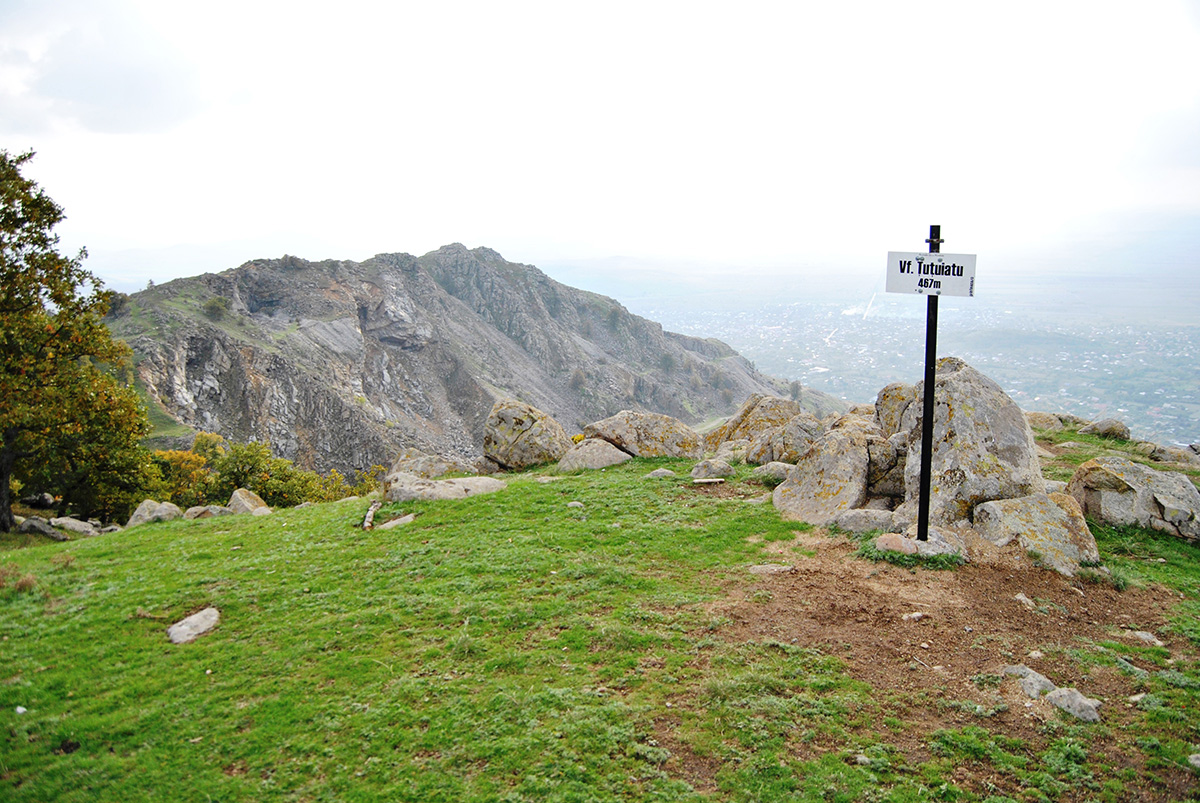
The highest point is peak Tutuiatu (Greece), which has a height of 467 meters and is atop the entire Dobrogea plateau. The landscape is dotted with eroded monoliths that can take different forms, depending on the imagination of those who visit the area.
The extension of the Peak Tutuiatu, north – west, is the tip Pietrosul Mare (426 meters) and height Pietrosu after the heights decrease gradually, reaching 100-170 meters, near the town Văcăreni, and spur Bugeac even reach 95 meters.
To the south – eastern tip Tutuiatu, the main peak of Macin Mountains continues through a series hilly peak as Hill Costiag (428 meters), Hill Negoiu tip Piatra Mare (380 meters) Hill David (354 meters) Hill Crapcea (344 meters), Hill Carapcea and carpel Hill (350 m).
Follow westward, first secondary peak called Peak key, Pricopan peak (370 meters) and massive Maegina (285 meters), which is headed by converging all uphill Hill carpel shell. Imagination bystanders is set to work in particular on Pricopanului. Here, they identified 562 species of higher plants and 14 associations herbaceous flora, and 72 taxa are considered endangered.
All westwards to a second secondary peak, parallel to the previous ones, consists of several massive nipple with insularity, drowned in loess and placed backstage, where differ hills Orliga (117 meters), Carcaliu (95 meters) Piatra Rîioasă (112 meters), Priopcea (409 meters) and Mircea Voda (206 meters). They are made of quartz, which predominate in the massive Priopcea of micaşituri, phyllite and developed in full steppe zone, low.
Last heights, which is in the form of massive completely isolated, are Iacobdeal with Victoria Peak (341 meters), and the Red Stone (both consist of granite), then hills Bujoarele (380 meters), it appears sandstone, shale and Devonian age limestone.

On the eastern side of Macin Mountains, to the valley Lozova, there are only two parallel ridges, the first consisting of Hill Coslugea (336 meters) and second in the hills scorched and Boclugea (393 meters), it is also in quartz phyllite, Proterozoic age boundaries.
Macin Mountains in northeast noodles Depression is superior longitudinal character (Niphon – Balabancea – Horia), which by Step Teilor extended in depresinea Luncaviţa.
The climate in Macin Mountains area has obvious characteristics with dry summers and winters steppe with small amounts of snow.
The average annual temperature has variations between the values of 9 and 10.8 degrees Celsius and the average annual rainfall is situated around 480 mm / year.
This climate determines the unique ecosystem in Europe a variety of ecosystem types of interference Pontic – submediterraneane, Central European and Asian conferring Macin Mountains miniature synthetic attribute of two continents: Europe and Asia.
With an area of 11 151.82 hectares access Macin Mountains National Park is on Route 22D, between the towns Macin and Horia on the European road E87, between the towns Macin-Jijila – Luncaviţa, and county road between the villages and Horia Luncaviţa.